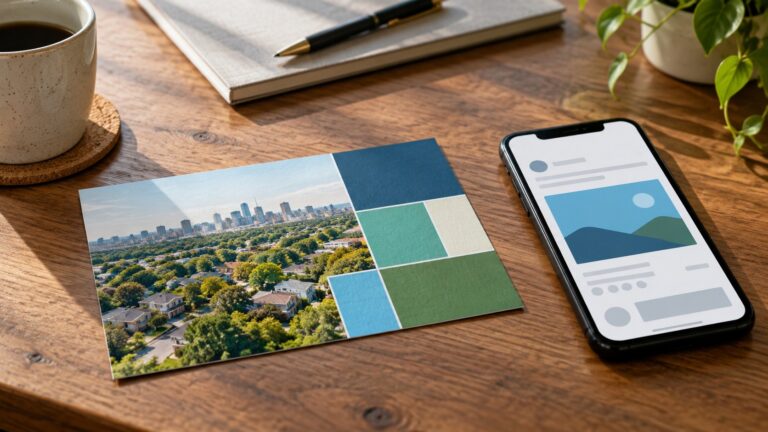

7 Things Every Effective EDDM Postcard Should Include
A postcard has a short opportunity to explain why it deserves attention. Filling every corner with services, photographs, coupons, and tiny print usually makes that harder. A useful design helps the reader recognize the offer, decide whether it fits, and find the next step.
These EDDM postcard design tips focus on clarity and production readiness. They do not guarantee responses, but they give a Columbia-area business a more thoughtful piece to test. Start with one audience, one offer, and one main action.
1. A headline a neighbor understands quickly
Lead with the customer need or useful result, using plain language. A roofing company might introduce a seasonal inspection service. A cleaning business might explain a particular cleaning package. A restaurant might feature a specific pickup special.
Make the headline large enough to read comfortably and avoid a slogan that means nothing without additional explanation. Read it aloud without the rest of the design. If it needs a paragraph of context, simplify it before choosing another font.
2. An offer with clear conditions
Explain what the reader receives, what they need to do, and any limits that matter. Include relevant dates or eligibility conditions in readable type. A vague discount with hidden qualifications can produce the wrong inquiries and frustrate customers.
Choose an offer the business can actually fulfill. A small contractor with limited appointment capacity should think about scheduling before promoting a short deadline. Make sure staff know how to answer questions about the exact promotion.
3. A visual hierarchy that supports the message
Use one strong image or a restrained set of graphics rather than several competing focal points. Contrast, spacing, and type size should guide the eye from headline to offer to response information. Leave breathing room around important elements.
Use suitable-quality artwork and check how the colors reproduce in the proof. A dark photograph behind small text can look attractive on a bright screen while becoming difficult to read on paper. Review the printed size, not only an enlarged design view.
4. A clear service area and business identity
Tell people who you are and where you work. A business serving only part of the Midlands should describe its practical area accurately. A route selection does not by itself tell every recipient whether their address qualifies for the offer.
Use your real business name and contact details consistently with your website and other materials. Avoid claims about awards, ratings, licenses, or guarantees unless they are current and supportable. Specific, accurate information builds a stronger introduction than broad promises.
5. One primary call to action
Ask the reader to take a clear step: request an estimate, view the menu, book a consultation, or call about the offer. A QR code can lead to a relevant mobile page, but include a readable alternative for people who prefer to type or call.
Test the destination
Scan a printed proof using more than one phone if possible. Confirm the link opens the intended page, the offer matches the postcard, and the form or phone number works. Keep a trackable link or distinct response code so the mailing can be evaluated.
6. Contact information people can actually read
Give the phone number and web address enough space and contrast. Verify every digit with a second person. A restaurant may need ordering information; a contractor may need a simple estimate request path. Provide the detail that helps the reader act, without burying it under a list of every social account.
7. A layout prepared for the mailing requirements
Confirm the finished dimensions, eligible mailpiece format, postal markings, and address area before artwork is approved. USPS EDDM requirements affect more than postage. Reserve the necessary clear space instead of trying to squeeze postal information into a finished design afterward.
Use the current USPS EDDM guidance and ask your production partner to review the layout. Keep important content away from trim and finishing areas, and confirm bleed requirements with the printer.
Questions before printing
Should the front and back repeat everything?
Keep the main message recognizable on either side, then use the second side to add useful detail. Repetition should support comprehension rather than double the clutter.
Can iShip&Pack help prepare the campaign?
Ask about design, postcard printing, and direct-mail preparation. Bring the offer, service area, budget, and timing. Call 803-303-8867 to plan a postcard that is clear to the reader and ready for the mailing process.